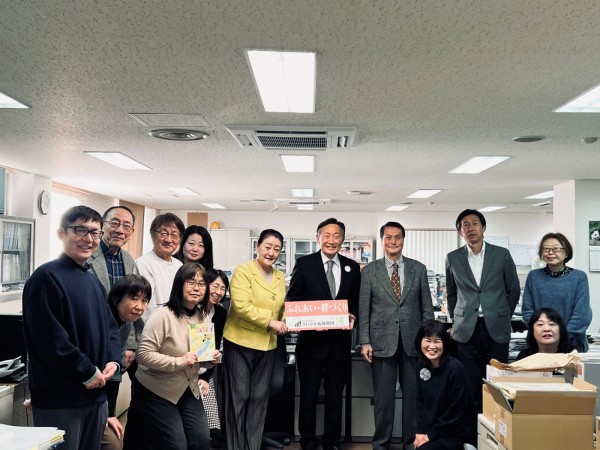
<Juch Myong-Yong, President of the Korean Association of Retired Persons (KARP), poses for a commemorative photo with officials of the Sawayaka Welfare Foundation after meeting with President Keiko Shimizu during his visit to the foundation in Japan on March 10.>
KARP Visits Japan’s Sawayaka Welfare Foundation
Juch Myong-Yong, President of the Korean Association of Retired Persons (KARP), met with Keiko Shimizu (清水慶子), President of the Sawayaka Welfare Foundation, on March 10 at the foundation’s office in Shiba Park, Minato-ku, Tokyo.
During their 90-minute meeting, the two discussed civil society–based care models and policy challenges facing rapidly aging societies.
The Korean government has begun expanding community-based care services nationwide starting this March. In this context, President Juch visited the Sawayaka Welfare Foundation to observe firsthand an example of a citizen-participation care model.
The foundation is widely known in Japan for promoting the “Fureai Kippu (触れ合い切符)” movement, a community-based care system built on citizen participation.
Under the Fureai Kippu system, residents who assist elderly people in their communities accumulate credits based on the time they spend providing care. These credits can later be used for their own care needs or for those of their family members. In essence, those who care for others today earn the right to receive care in the future.
This time-exchange care system, which substitutes time for money, was developed as a response to the challenges of an aging society, including the growing number of elderly people, shortages of care workers, and rising care costs.
The model is believed to have been influenced by the “Time Dollar” concept, first introduced in the United States about 40 years ago by social activist Edgar S. Cahn. The idea is based on the principle that everyone’s time has equal value, and it aims to build community networks of mutual support and care.
During the dialogue, both sides acknowledged the importance of citizen-driven care initiatives, while also openly discussing their practical limitations.
Following the meeting, President Juch noted:
“The realities faced by civil society organizations in Korea and Japan are surprisingly similar. Welfare models based solely on citizen participation are difficult to sustain. Organizations that maintain cooperative partnerships with local governments tend to operate more stably.”
Both sides identified several common challenges faced by civil society organizations, including:
financial sustainability of civic organizations
limitations in scaling citizen-participation care models
the need for cooperation with local governments and public institutions
They agreed that Korea and Japan face remarkably similar circumstances in addressing these issues.
The discussion also covered pension systems and employment challenges in a super-aging society. President Juch emphasized:
“Korea and Japan are among the fastest-aging countries in the world. Civil society, governments, and local communities must work together to develop new models for aging societies.”
The meeting served as an opportunity to reflect on the future of community-based care systems in the face of rapidly aging populations in both countries. The two sides agreed to continue exchanges and cooperation on citizen-participation care models and policies for aging societies.
Contact
Korean Association of Retired Persons (KARP)
Tel: +82-2-456-7850
Email: karp@karpkr.org